Tuesday, December 3, 2024

Very, Very Late — Secret Santicorn 2023: Domain Play

This is a bit later than I would have liked it to be originally, but life got in the way. Regardless, it's here now for dianerds over at the OSR discord server. I was specifically asked to come up with "Systems for homesteading, for letting players sow and reap the land in a variety of ways, for building strongholds and for watching communities grow." 

Now this is very, very late. Sorry about that. BUT, without further ado...

Homesteading

Maybe your PCs want to settle down and retire, have been gifted land for their deeds, or are moving into an abandoned structure. They WILL want to improve it, by some measure.


"Local Bonuses" Applies to Saving Throws made within the domain of a Homestead.

Here's a brief description of each of the Homestead qualities:
  • Destitute - Little more than a camp, or roofless ruin. The surrounding area is entirely wild or inhospitable. There's no agriculture, trade, or services available here.
  • Poor - A single small house or farmstead. Subsistence farming, with just enough to squirrel some money and resources away. No true services, but resource collection is possible.
  • Fair - Small farming community or trading post. Infrequent travelers and traders. One or two specialized services such as a blacksmith or stable. Produces or trades enough resources to maintain a comfortable larder.
  • Good - As Fair, but has walls and dedicated security. Active, frequent trade routes with potentially dozens of non-permanent residents.
  • Flourishing - As Good, but growing into a fully-fledged town. Numerous permanent structures, businesses, and housing. This will attract attention, whether good, or bad.

Roll on the "Monthly Event" Table each month to determine what happens to the Homestead. This event doesn't need to take place immediately, just over the course of the month.


For the random encounters, I suggest something like the "Wilderness Hexes" by d4caltrops. It provides a good set of hooks for the area surrounding the Homestead. There are a ton of resources available for this and I always find it's a good opportunity to crack open one of the books I have sitting on my shelf.

  • Squatters - Unwanted, potentially belligerent beings have moved into the camp. 1-in-6 they are hostile, 2-in-6 they flee while trying to steal from the camp. They will be back multiple times and seem willing to negotiate.
  • Animal Attack - A predatory, or perhaps just territorial creature has made its presence known. If left alone, it will eat food or accidentally destroy equipment. 1-in-6 chance each encounter it is violent. Maybe there's some way to help it.
  • Expansion Proposal - 1-6 chance for an investor to offer 75% of the funds needed to Advance in exchange for a favor at a later date (50% chance they're a devil in disguise). 2-in-6 chance of a quest worth 25% the necessary funds to Advance upon completion. 3-in-6 chance of discovering a new resource to exploit, such as minerals, crops, fur, rare herbs, marble, or timber.
  • Tax Collector - Somehow, the tax collectors have found out you exist. They will present legitimate documents demanding 10% of what it cost to advance to that tier, minimum of 10 gold. 25% chance any given tax collector is open to bribery. Failure to pay taxes in money or goods may result in attempted arrest.
  • Wandering Trader - Roll on a random treasure table 5 times. 4 items are 110% base price, and the 5th is marked down to 80% base price. No haggling, trades accepted.
  • Unusual Harvest - 2-in-6 chance the harvest of a random natural resource is tripled. 2-in-6 chance it is halved. 2-in-6 chance it is stolen or otherwise hindered from being collected.
  • Notable Resident - Either a high-level fighter, cleric, magic user, or craftsperson, nobility, or infamous criminal moves in. 1-6 chance for each.
  • Raid! - A fighting force with 1d6 times as many combatants as the Homestead (including the party) attempts to raid the Homestead. They will not fight to the death and will not harm anyone who surrenders, but will harm or kill those who resist. Their goal is to steal and ransack as much as they can in 1d6 x 10 minutes before fleeing back to where they came. If their leader is captured or killed, they will retreat. If enough damage is done, the GM may decide that the Homestead becomes Good (or worse) rather than Flourishing.

Tuesday, October 31, 2023

Halloween Special: GLORY 1-page RPG

Inspired by a conversation with a good friend about a setting where heroes volunteer to die in their prime so that they can be resurrected to fight evil in their home kingdom when needed. This is my first time using Affinity Publisher to do something like this and it seemed like a good way to practice and get used to the tool. PDF version found here. Happy Halloween!

Background image sourced from unsplash, skeletons from rawpixel and the Cloister Black font from dafont.

Saturday, October 14, 2023

Some Factions on the Continent

It's been a while since I have written anything for this blog, life has been crazy busy. To get back into the groove, here's a short list of some of the most influential Powers that Be in the setting of Beyond the Veil, in no particular order. Progress on the game marches forward at a slow but steady pace and soon I'll be happy with it mechanically and I can go add the setting information to the book instead of my notes.

1. The Basilisk. Father of Lies and Poison. Eternal boundary of the Father's Mire and the Oldwood. As old as time and equally as dangerous. His skin turns all that touches it to stone. His 4 eyes were plucked from his skull long, long ago after losing a bet and he desperately wants them back. More of a force of nature than an NPC, he's perfectly willing to interact with anyone passing by, and just as likely to not even notice you are passing over his ponderous mass. Sometimes not very smart people shoot cannons at him in an attempt to get him to move out of the way only to promptly be gobbled up by a head the size of a small hamlet, causing a brief, partial eclipse. He loves trivia and secrets, often bargaining safe passage across himself in exchange for news or novel riddles. Hs breath is said to be both ur-venom and panacea, the root of all toxins and source of all antidotes. At the very least, he can choose to inflict or cure all manner of horrid poisons on entire swathes of people that annoy or endear him.

2. Dryads. Dryads claim to be the oldest people of the Continent, second only to the Ents that birthed them. The city of Evergreen's namesake is the Ent that resides in the center of town, locked in eternal slumber. Dryads come in as many varietal forms as the trees of the Oldwood. Dryads have innate mastery and knowledge over plant life. They are not omniscient, however, and are just as capable of being tricked or scammed as any other person. They have a tentative peace with Humans and Ratlings, brokered by the various druidic sects and practitioners of the Old Ways and the Weaver Church. Unnecessary violence against the Oldwood is met with swift retribution, but they do not begrudge someone merely trying to survive. It is not always clear they can tell the difference between the two. They mingle freely with the people of Evergreen, and only enter Port City during negotiations brokered by The Church of the Weaver. The smell of industry sickens them almost as much as the controlled logging they have agreed to in exchange for an end to conflict with Port City and the overall preservation of the Oldwood.

Dryads by Midjourney

3. The Church of the Weaver. The oldest organized religion Humanity has on the Continent and maybe elsewhere. They perform magic by sewing the fabric of Reality, passing down teachings that allegedly stem from their deity, the eponymous Weaver. Spiders are sacred to them, believed to be the distant descendants of the Weaver themselves. Some devotees spend their entire life learning to translate the intricate language spiders use to communicate with their webs, seeking portents and knowledge. The spiders know many things from far away places they ought not to, even if most of it is inane and boring. Other clergy, known as Veil Piercers, strike out and become adventurers. They believe their calling to be seeking knowledge and relics to increase the Church's (and their own) position in the political and academic spheres. Their main temple is in Evergreen, but there are conclaves spread throughout the Oldwood and Port City. Worship is more rare in the Father's Mire, where most folks practice the Old Ways or ancestors worship. Evergreen itself is the oldest city on the Continent, having already been built and occupied by the time the Church of the Weaver began keeping records and taking census of the now 50,000 souls residing within 10 miles of its walls. More on the city itself in another post.

4. The Port City Oligarchy of Natural-Industrialists. Natural-Industrialists or "The Council" for short. A council of indeterminate size, made up of industrialists, naturalists, scientists, alchemists, and what is left of the gentry that oversees the slow but steady expansion of industry brought forth by the invention of the steam engine. They maintain the only naval force on the Continent, mainly to protect trade ships coming and going along the coastline. The city is packed and dense, with the metropolitan area housing some 100,000 souls fed by farms sitting on lands clear-cut from the Oldwood. Society still lingers on the long, contentious war with the Dryads only a decade prior. Most of the Council is concerned with their own eccentricities and securing their legacies for future generations, lest they be forgotten in the annals of history. Port City is only a few hundred years old, and has grown rapidly due to early industrial machinery and an influx of money from foreign trade. More on the city itself in another post.

5. Spirans. A predominantly naval civilization that hails from The Spire, an enormous relic of the days of the Giants that they have turned into the capital of their home archipelago. They primarily worship Oceanus, and have foundational disagreements with Old Ways practitioners, believing that the natural state of the world is to be covered in water. Every year, as a right of passage, all the residents who became of age go on a hunt to slay a Wyrm, a Sea Serpent, and collect its teeth. They carry the scars and blades made from the beast's teeth for the rest of their life, the flesh is used to create leather goods, and the meat is preserved to feed their sailors on long voyages. Tattooing yourself in honor of those that died in the hunt is common, and a good way to tell when and where a hunt took place, as well as how many lives it claimed. In recent years, Spire's theocratic triumvirate has declared war with the people of The Continent, and have made landfall in the Father's Mire with no clear goal beyond encroaching upon the Oldwood to raze it to the ground. They have an advanced navy and military doctrine, utilizing tactics both mundane and mystical. Their most fearsome warriors carry containers of pressurized, flammable liquid that can be expelled and ignited with great force, burning even in heavy rains and under water. Long before war was declared, thousands of Spirans had immigrated to the Continent, and vice versa, leading to no small amount of tension among communities, particularly in Port City. The war is not popular with the average citizen, but there is a zeal amongst soldiers that truly believe in their cause. Their position in the Father's Mire is solid and secure, but the Mirefolk and fae spirits of the swamp hamper their activities more than they had anticipated, allowing only small contingents of soldiers north towards the Oldwood.

6. The Mirefolk. A collective of independent villages and towns that call the Father's Mire home. They can often be found rafting the crisscrossing network of streams and wetlands, ferrying goods and people wherever they are needed. It is not uncommon for these rafts to be pulled by enormous crustaceans called "Crawd", or Dire Crayfish. These beasts of burden are the horse of the swamp, and invaluable to life there. Towns are built on stilted platforms near higher, drier patches of land with the expectation of flooding during the Spring thaw. As a rule of thumb, they practice the Old Ways, worshipping the local fae creatures and other powerful beings near where they make their homes. Blood magic, as elsewhere on the Continent, is common and normalized, often taking the form of personal totems or the occasional letting of blood to enhance one's personal ability for a short time. Towns are usually led by an alderman and large gatherings to both discuss news and hold court are common. Every Mirefolk has a story of experiencing something strange or unexplainable in the swamps, from the smallest Ratling to the sturdiest Crawdwrangler. Helping strangers is a rule, rather than the exception, notwithstanding obvious danger. Living in the Mire gives a person an almost supernatural ability to tell when a situation is going to turn bad in the eyes of outsiders, but locals insist it is just common sense. Nearly every Mirefolk will shoot Spiran scouts if they spot one, and have come together as a collective to hamper their activity as much as they safely can. The Spirans built their stronghold on ground considered sacred to the Mirefolk: a delta where the Ent known as Mangrove used to stand, now turned into impervious lumber, along with all the Dryads of the swamp.

Becky, nestling down for the Winter freeze. Source


Monday, June 5, 2023

Ratling Traditions and Festivals

Ratlings and Humans have coexisted for centuries, but in many ways, the culture of Ratlings is a secretive one. Not out of any sort of malice or ill-trust of humanity, but because most Humans simply never ask. Just like Humans, they have holidays, festivals, and significant life milestones.


Yearlings dancing around a Bronze Ring.

Yearling. A Ratling's first birthday is momentous, signaling their societal entrance into adulthood. This day is shared with littermates and non-family born in the same month. The first midnight of each month hosts this celebration, where dancing and music are had alongside fermented foods native to the region the Ratlings present call home. As part of this celebration, Ratlings share trade secrets between their families, ensuring they are passed on with the new generation.

Candlewhisk. Whenever a candle burns the last of its wick, Ratlings use bits of molten wax to style their fur. Ratlings aren't sure where this tradition began, but the few written histories of their people suggest it was started by ship-born ancestors protecting themselves from the salt air. Nowadays, most folks simply spike the fur on the top of their head, or near their tail.

Grainfill. When the first harvests of the fall season are interred into grain silos or cellars, it is traditional for farmers to offer the Ratlings living on their farmstead a tithe to hold them through the winter season. In return, the Ratlings keep the farmer's property free of bothersome vermin and making minor repairs. This ancient pact is so ingrained in both farming communities and rural Ratlings that questioning the act is met with superstitious gestures to ward off bad fortune coming from the person questioning it.

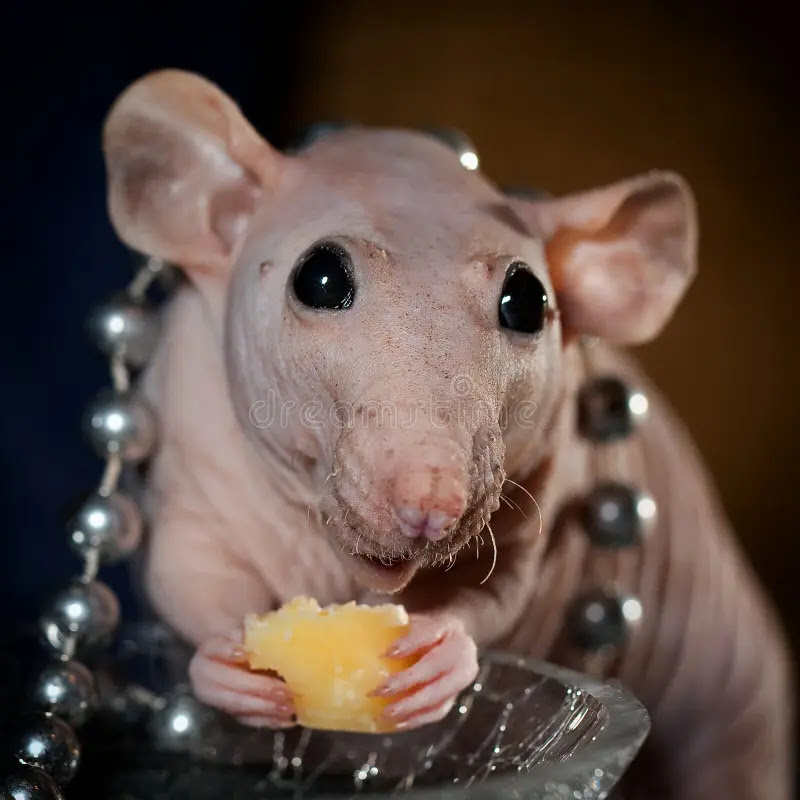
An esteemed denarian enjoying cheese as old as herself.

Decadance. A Ratling's 10th birthday is an incredibly important event. News will spread quickly, even through the Oldwood, and Ratlings from across the Continent will attempt to make the pilgrimage to pay respects to these venerable members of society. It is rare for more than a single individual to reach this age every few years. If they live to be 11 or 12, the party grows in size and complexity. Cities will warn citizens of these events so as not to be alarmed when thousands of Ratlings congregate in town squares. Non-Ratlings are allowed to participate in festivities, but not eat any of the food. In the final hours of the festivities, the Elder Ratling will choose 10 Ratlings from the thousands present to receive their secrets of longevity. No one has ever let those secrets become public knowledge.

Furnishtail. When a Ratling wishes to advertise their availability for partnering, they will adorn their tail in finery made by the practiced, delicate hands of Ratling jewelers, eschewing all other forms of covering. Gold, silver, and platinum are normally ignored beyond their magical utility by Ratlings, with this practice being the primary exception. Well-crafted jewelry shows confidence, resourcefulness, and connection to one's community. A Ratling who adorns their tail with human-made jewelry while seeking a partner is considered lazy, non-communal, or even selfish.

Mischief-making. Ratlings as young as 1 month of age will be sent to live and work in communities other than their own until they reach 6 months of age, when they are physically mature. They then have until their Yearling to decide if they wish to stay with that community, return home, or travel alongside Humans as they delve the Oldwood. Whatever they decide, they are always welcome in both their born and given communities. The decision to travel as an adventurer has been popular in recent years as it often means returning with stories, tremendous food supplies, and especially new skills or resources to share with one's home community. 

Wednesday, March 8, 2023

d12 Weird Woods

  1. Phoenixwood. A dark hardwood that smells of sulfur and ash. Each night, it bursts into flames. Each dawn it extinguishes itself. Its tree is most often found on high mountain peaks and are sometimes mistaken for bonfires or communities.
  2. Bindwood.  Ranges in color from off-white to parchment yellow. Bindwood is named after its tendency to grow in knotted patterns. It is cheap and fast growing, even when cut. If not constantly worn down, it will grow in length at a rate of 1 inch per day. It grows in temperate climates with lots of sunlight.
  3. Bloodwood. This hardwood tree is the color of dark chocolate with sienna sap. It metabolizes iron to form layers of flakey bark. 50 pounds of this bark can be melted down into 1 pound of iron. Bloodwood normally grows near areas where creatures die with great frequency such as battlefields.
  4. Gripwood. Excessively sappy, this light green wood supplements its metabolism by catching and dissolving insects. It is prized in the ship-making industry, and applications where shifting cargo are a concern. Outwardly, it looks like and grows in the same locations as an oak tree.
  5. Entwood. Harvested, almost always illegally, from the sleeping, living bodies of an Ent. Fae creatures will despise anyone who visibly associates with any Entwood not willingly given. Any wooden product made from it is waterproof, fireproof, and will never rot.
  6. Goblinwood. Somehow a goblin has become a part of this wood. It is unclear even to it how this has happened, but they cannot leave and will die if separated from the wood. Use this in conjunction with any other kind of wood.
  7. Lodewood. This shrubby, leafless plant grows exclusively underground on iron veins. iron left in contact with it for prolonged periods of times will slowly be absorbed, and non-iron metals are lightly repelled from it.
  8. Lushwood. This mangrove does not photosynthesize, but instead ferments captured insects, fish, and small mammals into strong alcohol. Every 10 pounds of animal biomass is converted into 1 pint of alcohol over the course of a week. It grows best in salty waters.
  9. Muskwood. Prized as a source of perfuming agents and sometimes burnt to achieve a mild hallucigenic effect. It requires extremely specific soil, water, and light conditions in order to achieve desirable aromas. Otherwise, the smoke is incredibly nauseating. Low-quality muskwood is often processed and turned into lantern oil.
  10. Wanderwood. A vined, migratory plant that travels in groves up to hundreds of acres in size. It behaves in a manner similar to herbivorous pack animals but is not sentient. Any objects made of Wanderwood will naturally attempt to join the nearest grove if left unattended.
  11. Spongewood. A subspecies of tumbleweed native to areas of high altitude and low humidity. It can absorb and store up to 100 times its dry weight in water for months at a time. It is popular among people trekking into harsh climates and fetches a high price for live plants.
  12. Bonewood. Stark white and hard as bone. It is exceptionally light and strong. It is an expensive, but popular, choice for the construction of wagons, furniture, and siege engines. Bonewood trees have no limbs and stick out of the ground in clusters of 5 or 6. Common superstition holds they are the fingerbones of long-dead giants.

Wednesday, January 11, 2023

The Order of the Knights Mercurial

In ages long since past, the first wellspring of mercury breached the surface of the world. Living metal, flowing like water, ended its secret vigil in the bones of the earth. The first Knight Mercurial discovered this wellspring and was enraptured by its unworldly beauty. The shimmering, silver surface called to him, a man true of heart and purpose. It called for him to submerge himself, and join in the chorus of the world. He drowned. His lungs flooded with slippery metal. His flesh and bones dissolved, replaced with quicksilver. His mind left him, lost in the overwhelming symphony he knew now to exist in the bowels of the earth. It returned just as fast, filled with a new vigor and sense of purpose and belonging. He rose out of the pool, baptized by the blood of stones.

Years of meditation followed, unfettered by sleep, food, or desire. Others found him, meditating in the grove, unaware of how much time had truly passed. Most ran and the news quickly spread of this strange creature. Many would try to kill him as a monster. None succeeded. Occasionally, though, a brave, earnest soul would step forward to challenge the Knight. Those came under his tutelage and became apostles of this new knightly order. These Knights traveled here and there, protecting travelers until they found mercurial wellsprings of their own to protect from the selfish and depraved. Centuries passed, and the Knights found themselves in far-flung places around The Continent and beyond. As technology advanced alongside magic, the number of Knights dwindled. Those that remain are the most powerful, the most clever, or the most well hidden. They quest no longer, and instead train alone, in preparation for worthy heirs to take their place so that they may rejoin their brothers and sisters within the bones of the world.


A Knight Mercurial is always found guarding a pool of liquid mercury, filled by a nearby spring that produces the metal. Each is looking for ultimate rest at the hands of someone that they deem worthy to learn from their Order. They will not decline a duel or challenge, but will insist on terms that must be met. Their armor is unique to each Knight, but all bear the heraldry of a caduceus, decorated as they each see fit. Thieves are attacked if seen stealing from the pool. If they are bested in the contest they present, they will impart their teachings to the victor only if they survive the "apotheotic process" of giving themselves over to the mercury.

A handful of these Knights can be found scattered around the Oldwood and have the following (system agnostic) characteristics in common:

Attacks 2x Longsword (1d8)
Initiative +2
AC as Plate
HD 4
Standard Movement

Mercurial Form - The Knight Mercurial can Move through any space at least 1 square inch wide, unhindered. They can escape restraints as an action.

Parry - When damaged, the Knight Mercurial may expend 1 HD and reduce the damage by that amount.

Special Maneuver - Each Knight has their own, specialized technique that they have perfected over countless decades.

from Wikipedia

The Knights

Some Knights are more skilled than others, and thus have more HD.

Sir Argus, the Flowing (5 HD)

Flowing Form -When Sir Argus takes damage, he may choose to spend HD and create an identical clone of himself. He may choose for either the clone or his real body to take the damage. If the clone takes damage, it is destroyed and Sir Argus loses as many hit points as the clone had total. The clones die if Sir Argus dies.

Lady Maya, the Quick

Quicksilver - Lady Maya's base movement speed is increased by 10 units. She has advantage on all Dexterity and Strength related Saves and Checks.

Sir Casmil, Knight Commander (8 HD)

Blood of the World - Sir Casmil appears to be unarmed, but actually wields the content of his mercurial spring. On each of his turns he may chose to do one of the following:
  • Regain 1 HD.
  • Emulate the technique of a living Knight Mercurial until the end of the next round.
  • Impale an adjacent target, dealing 1d4 damage to the target's HD directly if the attack hits.


Knight Totan, the Unmoving (6 HD)

Inertial Bulwark - Knight Totan wields only a tower shield. They decrease their AC by 1 and become immobile each time they take damage, until they willingly move. If hit while immobile, Knight Totan may roll HD. Their shield gains Xd4 damage on the next attack they make each time this ability triggers. 

Lady Prim, the Amalgam

Auric Extraction - When targeted by magic of any kind, Lady Prim may roll HD. If the result is 1-4 then she harmlessly absorbs the spell and retains her HD. If the result is a 5-6, she takes that much damage and suffers no effect from the spell.

Lady Calomel, the Restless

Formless - Lady Calomel has AC as Chain instead of Plate. The first attack that hits her each round instead misses. Once per round, Lady Calomel can transform her longsword into any 1 or 2 handed weapon of her choice as a free action.

Apotheosis

If you fully submerge yourself in a mercurial pool for one hour, make a CON save. If you fail, you die. You are filled with a deep sense of connection to the earth itself, and have a vague understanding of where each mercurial pool is located. Each day for the next 3 days, repeat this save. If you survive, your body becomes silver, malleable and cannot be moved against your will. As an action, you can change your appearance and weight, or sharpen your hand into a bladed weapon. You can squeeze through gaps as small as 1 inch as an action. In order to heal, you must ingest a pint of mercury or avoid heavy activity for 1 week. You only need to eat and drink once a week but failing to do so is lethal.

Tuesday, November 29, 2022

Potato Carrot and Leek Soup

  • 2 pounds of potatoes
  • 1 pound of carrots, peeled
  • 2 large leeks
  • Juice of 1 lemon
  • 2 tbsp. butter
  • 1 tbsp. olive oil
  • 1 tbsp. chopped dill
  • 2 tsp. rosemary
  • 2 tsp thyme
  • 4 cups beef or chicken stock
  • 4 cups of water
  • 1 chicken bullion cube
  • 4 oz. of sour cream
  • 1 cup of whole milk
  • Salt, garlic powder, onion powder and white pepper to taste

Cut all the vegetables into roughly 2 inch segments, cubing the unpeeled potatoes. Melt the butter and olive oil in a large pot and add the leeks and a pinch of salt and half the lemon juice, frying until fragrant over medium heat (around 5 minutes). Add the carrots and the rest of the herbs and spices and cook for another 2 or 3 minutes. Add the stock and water before adding the potatoes. Allow to come to a simmer and then add the sour cream, milk and remaining lemon juice and stir thoroughly, until fully incorporated. Bring to a boil and then reduce to a simmer and allow to cook until the potatoes are soft, around 30 minutes. Blend the solid ingredients either in a blender or crush them by hand, and mix them back into the liquid soup. Allow to simmer for another 15-20 minutes and add more seasoning to taste. Serve with a drizzle of olive oil, cracked black pepper and parmesan cheese.

Finally, my blog's title is no longer a bold-faced lie.

Sunday, August 28, 2022

Origami Folk

In abandoned libraries, lost ruins, dilapidated wizard towers and disorganized accountants' offices, the latent magic of the written word can reach a terminal mass, causing the paper to animate. Initially, it is nothing more than notes not being where they were last or pages missing from books. Given enough time, or a helping hand, the pages organize themselves into humanoid shapes, giving rise to Origami Folk.

They stand no taller than six inches and cannot speak, but can gesticulate and organize amongst themselves. Most importantly, they are themselves master paper-folders and are capable of building simple machinery with only paper and scraps scavenged from their environment. They can create new Folk, but any paper folded into other shapes will not animate for unknown reasons.

Origami Folk social structure seems to develop naturally according to a combination of their environment, their source material, and outsider influence. The societies they form are, thus far, communal in nature. It appears they have no sense of wealth and instead treasure items that will most benefit their settlement. Their sense of aesthetics is geometric, with intricate cut and folded paper being prized, and interesting baubles are placed on public display. They have no apparent laws, and infighting is rare unless two or more groups are consolidating their numbers together, forcing the collective to adjust their internal nonfictions.

One such enclave of these small wonders was discovered in a toxin-filled chamber of a king, lost to time. A citadel of sorts was suspended above the gas by paper chain links. A rudimentary elevator allowed "expedition teams" to descend into or ascend out of the toxic gas, wearing what appeared to be protective equipment, despite their lack of lungs to poison. This small retinue escorted the adventurers that stumbled upon them through the mists safely, and accepted a matchbook as payment. Reportedly, the same Origami Folk were later seen fighting off a slime, utilizing the gifted matches in a surprising display of tactics.

Another group, in an abandoned abbey library, created a circle of standing books and conducted rituals of great complexity in order to produce cantrip-like effects, usually involving the repair of their fellows or cleverly constructed machinery. Yet another, a hierarchy of knights astride compliant beetles, was witnessed waging war against another similar "kingdom" for resources in a noble's personal library, closed off after their death. it was only discovered after the groundskeeper reported the theft of hedge shears by dozens of insects.

The Origami Folk have an unprecedented resourcefulness and ability to adapt to new situations. Their cultures are as diverse as the books they find and assimilate. Their obviously frail nature leads them to incorporate parchment and leathers into water and fire resistant clothing. When torn, they utilize tar or glues to repair themselves. Generational knowledge is passed on through the transference of text before it fades out of existence. Origami Folk may not look it, but they embody the ideals of the authors that contributed to their texts and are capable of feats of heroism and treachery of incredible scope, relatively speaking. A collection of societies, bound to struggle in a world far to big for them, thrives in the musty, tome-filled places of the world. How long until they learn to write stories of their own?


Both images sourced from here

Boons of the Origami Folk

Should your players find themselves in the same dungeon as an enclave of Origami Folk, it is likely the paper-people are having some sort of trouble with either the local wildlife or some environmental change that jeopardizes their existence. Help them resolve the issue, and they will likely offer some sort of boon as payment.
  1. A needle, sharpened to an invisible point. It can pierce any surface once before breaking.
  2. 1d4 microprint scrolls containing random cantrips.
  3. The answer to any one question about the history of the enclave's home territory.
  4. A retinue of 6 warriors, willing to travel by your side to gain knowledge of the world. Collectively they have the stats of a 1st level Fighter.
  5. A powerful, hour long ritual resulting in a party member recovering 1 HD of damage.
  6. The key to a door, somewhere in the area.
  7. A vial of magic inks, unable to be erased or washed away.
  8. A "feast" in the party's honor. Paper food is prepared but is not consumed, nor is it nutritious. The Origami Folk seem especially thankful.

Monday, August 22, 2022

Where do birds go when it rains?


Source: British Library

It's a question everyone has asked at some point. When it rains, why are there no birds? Chickens of course return to their coops, so it would be reasonable to assume that wild birds return to their nests. But, if you ask anyone, no one has ever seen birds in their nest in the rain, almost as if they have disappeared. The learned men and women of the world have not reached a consensus on what causes this phenomenon. The radical view is that people simply do not see the nests because they themselves are too self-absorbed in staying dry to notice them. The vast majority of scholars, however, believe something more foundational is occurring.

Rain, as everyone knows, is the regular attempts of the god of the seas to flood the world and usurp control from the Earthmother, out of spite. Ducks, seagulls and pelicans are known agents of Oceanus. Other birds are believed to be distant cousins to the gulls, and as such carry inside themselves a small portion of the seas' power. Therefore, it stands to reason that rain is a direct result of birds taking flight into the clouds above and transforming themselves into rainwater, desperate to merge with the sea. 

Why then, do the rains stop after some time? This, too, is easily explained. Though they may carry an ancestral bond with their creator, Oceanus, birds prosper most while inland. "The early bird gets the worm" is a common expression amongst the farmers of The Continent, referring directly to the benefits one reaps when working the earth before sunrise. The reason rain stops and the world does not flood in its entirety is a conscious act by the terrestrial birds; rain draws worms to the surface of the soil, allowing the birds to gorge themselves and feed their young. A side effect of this avian self-interest is the creation of fertile farmlands and rivers essential for Humans and Ratlings to survive and thrive. It should not a be surprise that some villages venerate birds for their vital role in the continued well-being of crops.

Detractors from this mainstream stance argue that birds do not carry the necessary intelligence to organize such coordinated displays of restraint. To them, I reply that it was not until recently that it was discovered that coal was not full of fire spirits, but instead attracted them; science marches forward daily and mysteries are solved every year. A century ago it would have been thought impossible to treaty with the Dryads, and yet now they are a staunch ally of Evergreen. Is it impossible that birds do not in fact cause rain? I cannot make such a claim, but I strongly caution against assuming the negative until evidence presents itself to raise such doubts.

-Professor Henry Droop, Professor of Weatherology at the Natural-Industrial Society University of Port City (NSUP)

Friday, July 1, 2022

THE Elf

Oh boy, another one of these! Honestly they are really fun to do, and I highly recommend taking some creature you find yourself not using in your own game and make it very singular.

Humanity has always had stories of Elves. Mysterious, immortal beings that live in the deep and secret parts of the world. Most people believe them to be just stories and others swear to have met one while traveling. The truth is that Elves existed in great number, long before Humans even dreamed of building cities of their own. Only one Elf remains, and they are not too keen on that fact being known.

Broken Cycle - The Elf has no concept of death or decay. It seems such things as sad in the same way some people feel sad when they accidentally crush a butterfly. If killed, The Elf appears somewhere nearby, their old body having turned to dust.

Forever is a Good Start - The Elf is planning something for the far future. Whatever it may be leads them to various places to do seemingly mundane things. Their machinations are far reaching and arcane, and the results of their actions are never obvious.

Timelost Knowledge - The Elf knows about almost anything they are asked a question regarding. Their knowledge may be shallow, but they will know something. Getting them to share that information is challenging, and they will only do so if it somehow helps their own plans.

Out of Sight - The Elf can move through the space where living creatures do not see instantly.

False Civilization - Some people believe that Elves are a reclusive, wizened race, hiding from the rest of the world. This is a well-fabricated lie constructed by The Elf to more easily achieve their goals. No one has ever seen more than one Elf at once. The Elf never appears the same twice.

Elf Quirks
1. Always looks to the North when speaking.
2. Never sleeps, prefers to perish from exhaustion.
3. Refuses to talk about a specific and relevant topic.
4. Only speaks to humans to give directions to places it needs something done at indirectly.
5. Their eyes are made of starlight.
6. Only consumes honey made from white roses.

Thursday, June 23, 2022

GLOG Class: Meteor Swordsman

I saw a video on discord and I had to do something about it; it looked like something that would be fun to play in a game so here we are, presenting my first stab at a GLOG class:

The Meteor Swordsman

You gain +1 Movement and +1 Initiative for every Meteor Swordsman template you possess.
Starting Equipment: Leather Armor, meteorite metal sword, a letter revealing the location of a fallen meteorite, good shoes.
Starting Skill [d3] 1 = Soldier, 2 = Aristocrat, 3 = Hermit

A    Takeoff, Ignition
B    Impact, CON +1
C    Comet, STR +1
D    Momentum, Celestial Body

A. Takeoff

The first round of combat your movement increases by [template].

A. Ignition

You can take 1 fire damage and cause your meteorite sword to erupt in flames. Add +1d4 fire damage to damage rolls made with it. This effect lasts until the weapon is sheathed or the end of your next turn.

B. Impact

Ignition may be used to add 10 feet of knockback to any attack you make and applicable to yourself or your target.

C. Comet

Ignition may be used to jump up to 5 times your normal vertical or horizontal distance.

D. Momentum

You cannot be knocked down or lose your footing against your will, even if you are not in contact with the ground. You can use Ignition to ignore fall damage.

D. Celestial Body

Landing on a target transfers the fall damage you would normally take to the target with a successful attack. If you fall at least 10 feet, you can use Ignition to cause anything within 10 feet except you to take 1d6 fire damage when you land.

Meteorite Metal Sword

Forged from metal fallen from the sky in ominous conflagration, your meteorite sword was created to harness the unstoppable force of the heavens. Should it break, you will need to find and acquire a pound of meteorite iron and find a smith familiar with working it. Each sword is unique in appearance, and influences its wielder in some way for up to a week after being separated from the weapon, despite it being nonmagical.

d6 Sword Quirks

1. Lightly attracted towards iron.
2. Glows as night just enough to see the blade.
3. The blade is uncomfortably hot.
4. When swung, the air around it whistles.
5. The blade turns black when exposed to poisons or water.
6. Can be struck like a tuning fork; dogs dislike this.

d6 Influence on Wielder

1. You carry a salt lick for personal use.
2. Your first idea always seems like the best one.
3. Going indoors or below ground makes you jumpy.
4. You always pour the first bite of food and drink onto your blade at meals.
5. You refuse to turn over your weapon for any reason.
6. You tie a ribbon to the handle after every kill. You resent when someone takes your kill.

Saturday, June 18, 2022

Wagon Accessories

What do American pioneers and adventurers have in common? Not very much space to live while on the road. That is to say, they all have some form of mobile storage that often serves double duty as a place to sleep at night. Wagons are a staple of fantasy and adventure, and I have sadly not played in or ran a game where they were vital to the characters involved. This is changing with my continued playtest of Beyond the Veil (which has changed so much from what's on the blog that I ought to do a whole writeup about that!) reaching the point that soon, the parties involved will need not one, but two wagons to carry their provisions and supplies... not to mention their loot.

I was going to be adding this to the playtest originally, but decided I might as well throw it up for the world to see as well, since I haven't posted in a while and it is about time to get back on the metaphorical horse.

"Raiding the Wagons" by Ryan Pancoast


Onto Business


A person has 10 storage slots. Size 3 carts have 9 storage slots and can be pushed by hand. Size 4 wagons have 16 storage slots and require a mule or similar animal. Size 5 wagons have 25 storage slots and require a pair of workhorses or oxen.

Naturally, these animals require food, which takes up space on the wagon. Given most parties are 3-5 people strong, and that food for one person takes up a whole storage slot (animal feed is 5 days per slot), a five day journey into the wilderness takes 16-26 slots if everyone wants to eat every day, and that is just food! Needless to say, I can foresee my players wanting to solve this logistics issue by  buying a second cart and mule just to haul food, or buying smaller storage items (that hold more than they take up in slots) into wagons, which is fine and dandy. 

But, I ask myself, what if they have something else to tempt themselves with putting on their wagon?

Wagon Addons

Addon

Size Taken

Description

Artillery

6

Shipborne weaponry is just as useful on land. A heavy ballista or cannon securely mounted to the bed of the wagon.

Bunks

3

An integrated straw-filled sleeping pad that folds up in the side of the wagon. Each bed has a thin cloth cover to keep the bugs off at night.

Cargo Cover

1

A framed cover stretched across with canvas to keep the sun and rain off your precious cargo in transit.

Chalkboard

1

A hinged chalkboard mounted to the exterior of the wagon, useful for planning, chores assignment, and leaving cryptic messages.

Chicken Coop

2

Chickens lay an egg every day in the spring and summer, and make for excellent soup or alarms in the colder months. Each coop can house two birds.

Exterior Rack

+1

Extra storage is always in high demand. A wagon can have exterior storage installed up to its Size.

Floats

Size of Wagon

Cork-filled barrels mounted carefully around the exterior of the wagon keep the vessel from sinking in rivers or ponds.

Integrated Chest

+2

A chest beneath the seat of the wagon offers a handy place to keep an emergency blunderbuss. This can only be taken once per wagon.

Kitchen

5

Includes a wash basin, slate countertop, small iron stove, a pot, and a set of knives.

Lantern Sconces

0

Exterior mounted sconces on the sides of the wagon ensure that no grue nor bandit can approach unannounced.

Library

3

Integrated shelving can hold up to 50 tomes, manuals, scrolls or other pieces of literature, protecting them from the elements.

Dovecote

2

A messenger pigeon can be the difference between life and death in the wilderness. This can house three such pigeons.

Pipe Organ

10

Serves as entertainment, a distraction, or attractor.

Prisoner Cage

5

Wrought-iron bars and a heavy-duty lock keep up to three bounty targets safely contained until delivered to the appropriate authorities.

Rainwater Collector

4

Drinkable water can be hard to find in the wilds, let alone enough to slake the thirst of adventurers and their animal companions. A day of rain will fill the barrel, substituting a meal in dire straits.

Religious Altar

1

Whether you worship the sun, the Weaver, or your ancestors, you find solace in this idol.

Secret Compartment

Size of Compartment

Taxes really are the worst. Sneak fine liquors and other things into and out of cities with a false-bottomed wagon. The ruse will be revealed only under prolonged scrutiny.

Shop Stall

7

A series of fold-out benchtops and shutters. Fully walls the wagon off, adds a shingled roof, exterior locking door, and includes a chalkboard.

Silver Inlay

0

Anti-magic engravings integrated into the frame of the wagon keeps your mobile home from being suddenly dissolved, splintered, or otherwise magically altered.

Snow Runners

4

When winter hits and the snow begins to pile high, wheels   become ineffective. Swap them out for runners to avoid delays in travel and keep your wagon above the snowline.

Spare Wheel

1

Sometimes wheels break, it’s always good to have a few spares.

Spring Assist

6

Should a wagon become swamped or otherwise stuck, it can be a deadly endeavor trying to free it. Passively wound using the latest technology, these spring-loaded arms can be discharged to correct your vehicle in a pinch. Recharges after traveling 50 miles.

Stilts

4

Heavy winds, and flash-flooding are excellent examples of scenarios where one might wish their wagon was bolted to the ground. These stilts can be deployed in only one minute and prevent a wagon from being forcibly moved in winds and waters up to a hurricane in strength.

Waterproofing

0

A thick coating of tar and proprietary alchemicals seals all the holes in a wooden vessel, enabling it to serve as an emergency raft or lean-to.

Winch

2

Thick rope wrapped around a spindle with a hook on one end and a crank on the other allows creative folks to surmount any obstacle they may come across.


The thought of a party having a wagon dedicated to playing the "1812 Overture", complete with live cannon fire is a powerful one in my mind.