Monday, June 5, 2023

Ratling Traditions and Festivals

Ratlings and Humans have coexisted for centuries, but in many ways, the culture of Ratlings is a secretive one. Not out of any sort of malice or ill-trust of humanity, but because most Humans simply never ask. Just like Humans, they have holidays, festivals, and significant life milestones.


Yearlings dancing around a Bronze Ring.

Yearling. A Ratling's first birthday is momentous, signaling their societal entrance into adulthood. This day is shared with littermates and non-family born in the same month. The first midnight of each month hosts this celebration, where dancing and music are had alongside fermented foods native to the region the Ratlings present call home. As part of this celebration, Ratlings share trade secrets between their families, ensuring they are passed on with the new generation.

Candlewhisk. Whenever a candle burns the last of its wick, Ratlings use bits of molten wax to style their fur. Ratlings aren't sure where this tradition began, but the few written histories of their people suggest it was started by ship-born ancestors protecting themselves from the salt air. Nowadays, most folks simply spike the fur on the top of their head, or near their tail.

Grainfill. When the first harvests of the fall season are interred into grain silos or cellars, it is traditional for farmers to offer the Ratlings living on their farmstead a tithe to hold them through the winter season. In return, the Ratlings keep the farmer's property free of bothersome vermin and making minor repairs. This ancient pact is so ingrained in both farming communities and rural Ratlings that questioning the act is met with superstitious gestures to ward off bad fortune coming from the person questioning it.
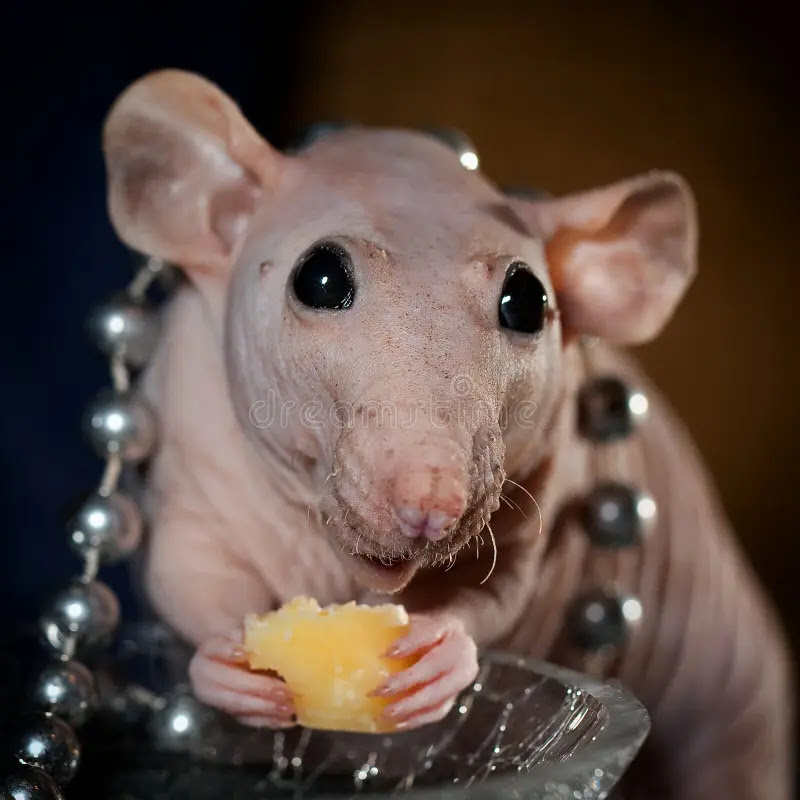
An esteemed denarian enjoying cheese as old as herself.

Decadance. A Ratling's 10th birthday is an incredibly important event. News will spread quickly, even through the Oldwood, and Ratlings from across the Continent will attempt to make the pilgrimage to pay respects to these venerable members of society. It is rare for more than a single individual to reach this age every few years. If they live to be 11 or 12, the party grows in size and complexity. Cities will warn citizens of these events so as not to be alarmed when thousands of Ratlings congregate in town squares. Non-Ratlings are allowed to participate in festivities, but not eat any of the food. In the final hours of the festivities, the Elder Ratling will choose 10 Ratlings from the thousands present to receive their secrets of longevity. No one has ever let those secrets become public knowledge.

Furnishtail. When a Ratling wishes to advertise their availability for partnering, they will adorn their tail in finery made by the practiced, delicate hands of Ratling jewelers, eschewing all other forms of covering. Gold, silver, and platinum are normally ignored beyond their magical utility by Ratlings, with this practice being the primary exception. Well-crafted jewelry shows confidence, resourcefulness, and connection to one's community. A Ratling who adorns their tail with human-made jewelry while seeking a partner is considered lazy, non-communal, or even selfish.

Mischief-making. Ratlings as young as 1 month of age will be sent to live and work in communities other than their own until they reach 6 months of age, when they are physically mature. They then have until their Yearling to decide if they wish to stay with that community, return home, or travel alongside Humans as they delve the Oldwood. Whatever they decide, they are always welcome in both their born and given communities. The decision to travel as an adventurer has been popular in recent years as it often means returning with stories, tremendous food supplies, and especially new skills or resources to share with one's home community. 

Wednesday, March 8, 2023

d12 Weird Woods

  1. Phoenixwood. A dark hardwood that smells of sulfur and ash. Each night, it bursts into flames. Each dawn it extinguishes itself. Its tree is most often found on high mountain peaks and are sometimes mistaken for bonfires or communities.
  2. Bindwood.  Ranges in color from off-white to parchment yellow. Bindwood is named after its tendency to grow in knotted patterns. It is cheap and fast growing, even when cut. If not constantly worn down, it will grow in length at a rate of 1 inch per day. It grows in temperate climates with lots of sunlight.
  3. Bloodwood. This hardwood tree is the color of dark chocolate with sienna sap. It metabolizes iron to form layers of flakey bark. 50 pounds of this bark can be melted down into 1 pound of iron. Bloodwood normally grows near areas where creatures die with great frequency such as battlefields.
  4. Gripwood. Excessively sappy, this light green wood supplements its metabolism by catching and dissolving insects. It is prized in the ship-making industry, and applications where shifting cargo are a concern. Outwardly, it looks like and grows in the same locations as an oak tree.
  5. Entwood. Harvested, almost always illegally, from the sleeping, living bodies of an Ent. Fae creatures will despise anyone who visibly associates with any Entwood not willingly given. Any wooden product made from it is waterproof, fireproof, and will never rot.
  6. Goblinwood. Somehow a goblin has become a part of this wood. It is unclear even to it how this has happened, but they cannot leave and will die if separated from the wood. Use this in conjunction with any other kind of wood.
  7. Lodewood. This shrubby, leafless plant grows exclusively underground on iron veins. iron left in contact with it for prolonged periods of times will slowly be absorbed, and non-iron metals are lightly repelled from it.
  8. Lushwood. This mangrove does not photosynthesize, but instead ferments captured insects, fish, and small mammals into strong alcohol. Every 10 pounds of animal biomass is converted into 1 pint of alcohol over the course of a week. It grows best in salty waters.
  9. Muskwood. Prized as a source of perfuming agents and sometimes burnt to achieve a mild hallucigenic effect. It requires extremely specific soil, water, and light conditions in order to achieve desirable aromas. Otherwise, the smoke is incredibly nauseating. Low-quality muskwood is often processed and turned into lantern oil.
  10. Wanderwood. A vined, migratory plant that travels in groves up to hundreds of acres in size. It behaves in a manner similar to herbivorous pack animals but is not sentient. Any objects made of Wanderwood will naturally attempt to join the nearest grove if left unattended.
  11. Spongewood. A subspecies of tumbleweed native to areas of high altitude and low humidity. It can absorb and store up to 100 times its dry weight in water for months at a time. It is popular among people trekking into harsh climates and fetches a high price for live plants.
  12. Bonewood. Stark white and hard as bone. It is exceptionally light and strong. It is an expensive, but popular, choice for the construction of wagons, furniture, and siege engines. Bonewood trees have no limbs and stick out of the ground in clusters of 5 or 6. Common superstition holds they are the fingerbones of long-dead giants.

Wednesday, January 11, 2023

The Order of the Knights Mercurial

In ages long since past, the first wellspring of mercury breached the surface of the world. Living metal, flowing like water, ended its secret vigil in the bones of the earth. The first Knight Mercurial discovered this wellspring and was enraptured by its unworldly beauty. The shimmering, silver surface called to him, a man true of heart and purpose. It called for him to submerge himself, and join in the chorus of the world. He drowned. His lungs flooded with slippery metal. His flesh and bones dissolved, replaced with quicksilver. His mind left him, lost in the overwhelming symphony he knew now to exist in the bowels of the earth. It returned just as fast, filled with a new vigor and sense of purpose and belonging. He rose out of the pool, baptized by the blood of stones.

Years of meditation followed, unfettered by sleep, food, or desire. Others found him, meditating in the grove, unaware of how much time had truly passed. Most ran and the news quickly spread of this strange creature. Many would try to kill him as a monster. None succeeded. Occasionally, though, a brave, earnest soul would step forward to challenge the Knight. Those came under his tutelage and became apostles of this new knightly order. These Knights traveled here and there, protecting travelers until they found mercurial wellsprings of their own to protect from the selfish and depraved. Centuries passed, and the Knights found themselves in far-flung places around The Continent and beyond. As technology advanced alongside magic, the number of Knights dwindled. Those that remain are the most powerful, the most clever, or the most well hidden. They quest no longer, and instead train alone, in preparation for worthy heirs to take their place so that they may rejoin their brothers and sisters within the bones of the world.


A Knight Mercurial is always found guarding a pool of liquid mercury, filled by a nearby spring that produces the metal. Each is looking for ultimate rest at the hands of someone that they deem worthy to learn from their Order. They will not decline a duel or challenge, but will insist on terms that must be met. Their armor is unique to each Knight, but all bear the heraldry of a caduceus, decorated as they each see fit. Thieves are attacked if seen stealing from the pool. If they are bested in the contest they present, they will impart their teachings to the victor only if they survive the "apotheotic process" of giving themselves over to the mercury.

A handful of these Knights can be found scattered around the Oldwood and have the following (system agnostic) characteristics in common:

Attacks 2x Longsword (1d8)
Initiative +2
AC as Plate
HD 4
Standard Movement

Mercurial Form - The Knight Mercurial can Move through any space at least 1 square inch wide, unhindered. They can escape restraints as an action.

Parry - When damaged, the Knight Mercurial may expend 1 HD and reduce the damage by that amount.

Special Maneuver - Each Knight has their own, specialized technique that they have perfected over countless decades.

from Wikipedia

The Knights

Some Knights are more skilled than others, and thus have more HD.

Sir Argus, the Flowing (5 HD)

Flowing Form -When Sir Argus takes damage, he may choose to spend HD and create an identical clone of himself. He may choose for either the clone or his real body to take the damage. If the clone takes damage, it is destroyed and Sir Argus loses as many hit points as the clone had total. The clones die if Sir Argus dies.

Lady Maya, the Quick

Quicksilver - Lady Maya's base movement speed is increased by 10 units. She has advantage on all Dexterity and Strength related Saves and Checks.

Sir Casmil, Knight Commander (8 HD)

Blood of the World - Sir Casmil appears to be unarmed, but actually wields the content of his mercurial spring. On each of his turns he may chose to do one of the following:
  • Regain 1 HD.
  • Emulate the technique of a living Knight Mercurial until the end of the next round.
  • Impale an adjacent target, dealing 1d4 damage to the target's HD directly if the attack hits.


Knight Totan, the Unmoving (6 HD)

Inertial Bulwark - Knight Totan wields only a tower shield. They decrease their AC by 1 and become immobile each time they take damage, until they willingly move. If hit while immobile, Knight Totan may roll HD. Their shield gains Xd4 damage on the next attack they make each time this ability triggers. 

Lady Prim, the Amalgam

Auric Extraction - When targeted by magic of any kind, Lady Prim may roll HD. If the result is 1-4 then she harmlessly absorbs the spell and retains her HD. If the result is a 5-6, she takes that much damage and suffers no effect from the spell.

Lady Calomel, the Restless

Formless - Lady Calomel has AC as Chain instead of Plate. The first attack that hits her each round instead misses. Once per round, Lady Calomel can transform her longsword into any 1 or 2 handed weapon of her choice as a free action.

Apotheosis

If you fully submerge yourself in a mercurial pool for one hour, make a CON save. If you fail, you die. You are filled with a deep sense of connection to the earth itself, and have a vague understanding of where each mercurial pool is located. Each day for the next 3 days, repeat this save. If you survive, your body becomes silver, malleable and cannot be moved against your will. As an action, you can change your appearance and weight, or sharpen your hand into a bladed weapon. You can squeeze through gaps as small as 1 inch as an action. In order to heal, you must ingest a pint of mercury or avoid heavy activity for 1 week. You only need to eat and drink once a week but failing to do so is lethal.

Tuesday, November 29, 2022

Potato Carrot and Leek Soup

  • 2 pounds of potatoes
  • 1 pound of carrots, peeled
  • 2 large leeks
  • Juice of 1 lemon
  • 2 tbsp. butter
  • 1 tbsp. olive oil
  • 1 tbsp. chopped dill
  • 2 tsp. rosemary
  • 2 tsp thyme
  • 4 cups beef or chicken stock
  • 4 cups of water
  • 1 chicken bullion cube
  • 4 oz. of sour cream
  • 1 cup of whole milk
  • Salt, garlic powder, onion powder and white pepper to taste

Cut all the vegetables into roughly 2 inch segments, cubing the unpeeled potatoes. Melt the butter and olive oil in a large pot and add the leeks and a pinch of salt and half the lemon juice, frying until fragrant over medium heat (around 5 minutes). Add the carrots and the rest of the herbs and spices and cook for another 2 or 3 minutes. Add the stock and water before adding the potatoes. Allow to come to a simmer and then add the sour cream, milk and remaining lemon juice and stir thoroughly, until fully incorporated. Bring to a boil and then reduce to a simmer and allow to cook until the potatoes are soft, around 30 minutes. Blend the solid ingredients either in a blender or crush them by hand, and mix them back into the liquid soup. Allow to simmer for another 15-20 minutes and add more seasoning to taste. Serve with a drizzle of olive oil, cracked black pepper and parmesan cheese.

Finally, my blog's title is no longer a bold-faced lie.

Sunday, August 28, 2022

Origami Folk

In abandoned libraries, lost ruins, dilapidated wizard towers and disorganized accountants' offices, the latent magic of the written word can reach a terminal mass, causing the paper to animate. Initially, it is nothing more than notes not being where they were last or pages missing from books. Given enough time, or a helping hand, the pages organize themselves into humanoid shapes, giving rise to Origami Folk.

They stand no taller than six inches and cannot speak, but can gesticulate and organize amongst themselves. Most importantly, they are themselves master paper-folders and are capable of building simple machinery with only paper and scraps scavenged from their environment. They can create new Folk, but any paper folded into other shapes will not animate for unknown reasons.

Origami Folk social structure seems to develop naturally according to a combination of their environment, their source material, and outsider influence. The societies they form are, thus far, communal in nature. It appears they have no sense of wealth and instead treasure items that will most benefit their settlement. Their sense of aesthetics is geometric, with intricate cut and folded paper being prized, and interesting baubles are placed on public display. They have no apparent laws, and infighting is rare unless two or more groups are consolidating their numbers together, forcing the collective to adjust their internal nonfictions.

One such enclave of these small wonders was discovered in a toxin-filled chamber of a king, lost to time. A citadel of sorts was suspended above the gas by paper chain links. A rudimentary elevator allowed "expedition teams" to descend into or ascend out of the toxic gas, wearing what appeared to be protective equipment, despite their lack of lungs to poison. This small retinue escorted the adventurers that stumbled upon them through the mists safely, and accepted a matchbook as payment. Reportedly, the same Origami Folk were later seen fighting off a slime, utilizing the gifted matches in a surprising display of tactics.

Another group, in an abandoned abbey library, created a circle of standing books and conducted rituals of great complexity in order to produce cantrip-like effects, usually involving the repair of their fellows or cleverly constructed machinery. Yet another, a hierarchy of knights astride compliant beetles, was witnessed waging war against another similar "kingdom" for resources in a noble's personal library, closed off after their death. it was only discovered after the groundskeeper reported the theft of hedge shears by dozens of insects.

The Origami Folk have an unprecedented resourcefulness and ability to adapt to new situations. Their cultures are as diverse as the books they find and assimilate. Their obviously frail nature leads them to incorporate parchment and leathers into water and fire resistant clothing. When torn, they utilize tar or glues to repair themselves. Generational knowledge is passed on through the transference of text before it fades out of existence. Origami Folk may not look it, but they embody the ideals of the authors that contributed to their texts and are capable of feats of heroism and treachery of incredible scope, relatively speaking. A collection of societies, bound to struggle in a world far to big for them, thrives in the musty, tome-filled places of the world. How long until they learn to write stories of their own?


Both images sourced from here

Boons of the Origami Folk

Should your players find themselves in the same dungeon as an enclave of Origami Folk, it is likely the paper-people are having some sort of trouble with either the local wildlife or some environmental change that jeopardizes their existence. Help them resolve the issue, and they will likely offer some sort of boon as payment.
  1. A needle, sharpened to an invisible point. It can pierce any surface once before breaking.
  2. 1d4 microprint scrolls containing random cantrips.
  3. The answer to any one question about the history of the enclave's home territory.
  4. A retinue of 6 warriors, willing to travel by your side to gain knowledge of the world. Collectively they have the stats of a 1st level Fighter.
  5. A powerful, hour long ritual resulting in a party member recovering 1 HD of damage.
  6. The key to a door, somewhere in the area.
  7. A vial of magic inks, unable to be erased or washed away.
  8. A "feast" in the party's honor. Paper food is prepared but is not consumed, nor is it nutritious. The Origami Folk seem especially thankful.

Monday, August 22, 2022

Where do birds go when it rains?


Source: British Library

It's a question everyone has asked at some point. When it rains, why are there no birds? Chickens of course return to their coops, so it would be reasonable to assume that wild birds return to their nests. But, if you ask anyone, no one has ever seen birds in their nest in the rain, almost as if they have disappeared. The learned men and women of the world have not reached a consensus on what causes this phenomenon. The radical view is that people simply do not see the nests because they themselves are too self-absorbed in staying dry to notice them. The vast majority of scholars, however, believe something more foundational is occurring.

Rain, as everyone knows, is the regular attempts of the god of the seas to flood the world and usurp control from the Earthmother, out of spite. Ducks, seagulls and pelicans are known agents of Oceanus. Other birds are believed to be distant cousins to the gulls, and as such carry inside themselves a small portion of the seas' power. Therefore, it stands to reason that rain is a direct result of birds taking flight into the clouds above and transforming themselves into rainwater, desperate to merge with the sea. 

Why then, do the rains stop after some time? This, too, is easily explained. Though they may carry an ancestral bond with their creator, Oceanus, birds prosper most while inland. "The early bird gets the worm" is a common expression amongst the farmers of The Continent, referring directly to the benefits one reaps when working the earth before sunrise. The reason rain stops and the world does not flood in its entirety is a conscious act by the terrestrial birds; rain draws worms to the surface of the soil, allowing the birds to gorge themselves and feed their young. A side effect of this avian self-interest is the creation of fertile farmlands and rivers essential for Humans and Ratlings to survive and thrive. It should not a be surprise that some villages venerate birds for their vital role in the continued well-being of crops.

Detractors from this mainstream stance argue that birds do not carry the necessary intelligence to organize such coordinated displays of restraint. To them, I reply that it was not until recently that it was discovered that coal was not full of fire spirits, but instead attracted them; science marches forward daily and mysteries are solved every year. A century ago it would have been thought impossible to treaty with the Dryads, and yet now they are a staunch ally of Evergreen. Is it impossible that birds do not in fact cause rain? I cannot make such a claim, but I strongly caution against assuming the negative until evidence presents itself to raise such doubts.

-Professor Henry Droop, Professor of Weatherology at the Natural-Industrial Society University of Port City (NSUP)

Friday, July 1, 2022

THE Elf

Oh boy, another one of these! Honestly they are really fun to do, and I highly recommend taking some creature you find yourself not using in your own game and make it very singular.

Humanity has always had stories of Elves. Mysterious, immortal beings that live in the deep and secret parts of the world. Most people believe them to be just stories and others swear to have met one while traveling. The truth is that Elves existed in great number, long before Humans even dreamed of building cities of their own. Only one Elf remains, and they are not too keen on that fact being known.

Broken Cycle - The Elf has no concept of death or decay. It seems such things as sad in the same way some people feel sad when they accidentally crush a butterfly. If killed, The Elf appears somewhere nearby, their old body having turned to dust.

Forever is a Good Start - The Elf is planning something for the far future. Whatever it may be leads them to various places to do seemingly mundane things. Their machinations are far reaching and arcane, and the results of their actions are never obvious.

Timelost Knowledge - The Elf knows about almost anything they are asked a question regarding. Their knowledge may be shallow, but they will know something. Getting them to share that information is challenging, and they will only do so if it somehow helps their own plans.

Out of Sight - The Elf can move through the space where living creatures do not see instantly.

False Civilization - Some people believe that Elves are a reclusive, wizened race, hiding from the rest of the world. This is a well-fabricated lie constructed by The Elf to more easily achieve their goals. No one has ever seen more than one Elf at once. The Elf never appears the same twice.

Elf Quirks
1. Always looks to the North when speaking.
2. Never sleeps, prefers to perish from exhaustion.
3. Refuses to talk about a specific and relevant topic.
4. Only speaks to humans to give directions to places it needs something done at indirectly.
5. Their eyes are made of starlight.
6. Only consumes honey made from white roses.